








Underground buildings offer many benefits (see "Top Ten Reasons to Bury a Building" in our article archives for brief descriptions of some of them). Is there a way to take advantage of these benefits without actually burrowing into the earth? In other words, is there any middle ground between surface and subsurface?
Actually, there are several ways to construct a hybrid surface/subsurface building. Architect Antoine Predock uses one technique (see "Breaching the Boundary" on this site), creating structures that are simultaneously above and below ground. Another common procedure is to build at ground level, or perhaps a few feet below, and then pack dirt around the outside walls. These sloping earthen embankments are called "berms," and they can be attractively landscaped; in some instances, soil is also placed on the roof. Bermed buildings are said to be "earth sheltered" rather than "underground."
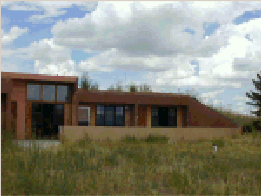
From the front, this ranch house in central New Mexico looks like a fairly typical, adobe-style home. On second glance, however, it becomes apparent that the greenery visible above the structure is too near to be the tops of backyard trees. Rather, it is a scattering of desert shrubs growing on the roof. It also becomes apparent that the courtyard wall extending out from the right-hand edge of the house is actually a retaining wall. Behind it, the ground clearly slopes up toward the house.
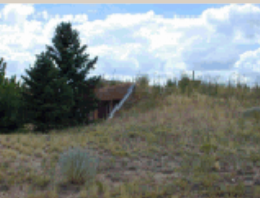
Walking to the right, past that wall, and looking back at the house, you see the building practically disappear into the earth. Although it was built at ground level, the structure is now covered with soil on the top and three of its four sides. Because there are no windows in the three bermed walls, the exposed wall consists almost entirely of glass that allows light to pour into the building's interior.
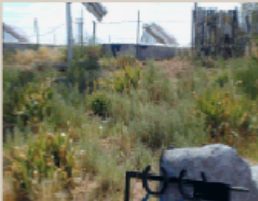
One of the primary advantages of earth sheltering is energy efficiency. Consider the example of Nancy Roux, who lives in an earth-sheltered home outside Mountainair, New Mexico. The elevation at her house is somewhat above the town's 6500 feet. In the month of January, the high temperature averages 46EF, with an average low of 19E. The average annual snowfall is 34 inches. Nancy has a wood stove and a fireplace in her cozy home, but she says they are merely decorative; she hasn't needed them for warmth. In fact, enjoying the holidays last December, she used her fireplace all day; finally, she had to open windows and skylights when the room temperature reached 95E. In this photo, taken from one side of the house, open skylights rise above the ground-level roof. Watch this site for more information about Nancy's lovely home, which she hand built, largely from discarded tires and empty beverage cans!
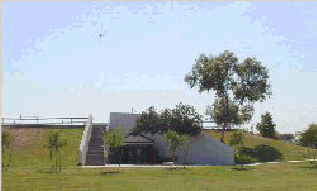
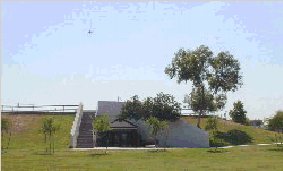
Earth sheltering can be quite effective for individual residences, but it can also be used on a larger scale. The Ann Ott Elementary School in Phoenix, Arizona, is one example. The insulation provided by the bermed walls certainly helps lower climate control costs, especially during the summer (the school operates on a year-round schedule). And installing basketball courts on the concrete-finished roof maximizes efficient use of the school's land area.
Actually, there are several ways to construct a hybrid surface/subsurface building. Architect Antoine Predock uses one technique (see "Breaching the Boundary" on this site), creating structures that are simultaneously above and below ground. Another common procedure is to build at ground level, or perhaps a few feet below, and then pack dirt around the outside walls. These sloping earthen embankments are called "berms," and they can be attractively landscaped; in some instances, soil is also placed on the roof. Bermed buildings are said to be "earth sheltered" rather than "underground."
From the front, this ranch house in central New Mexico looks like a fairly typical, adobe-style home. On second glance, however, it becomes apparent that the greenery visible above the structure is too near to be the tops of backyard trees. Rather, it is a scattering of desert shrubs growing on the roof. It also becomes apparent that the courtyard wall extending out from the right-hand edge of the house is actually a retaining wall. Behind it, the ground clearly slopes up toward the house.
Walking to the right, past that wall, and looking back at the house, you see the building practically disappear into the earth. Although it was built at ground level, the structure is now covered with soil on the top and three of its four sides. Because there are no windows in the three bermed walls, the exposed wall consists almost entirely of glass that allows light to pour into the building's interior.
One of the primary advantages of earth sheltering is energy efficiency. Consider the example of Nancy Roux, who lives in an earth-sheltered home outside Mountainair, New Mexico. The elevation at her house is somewhat above the town's 6500 feet. In the month of January, the high temperature averages 46EF, with an average low of 19E. The average annual snowfall is 34 inches. Nancy has a wood stove and a fireplace in her cozy home, but she says they are merely decorative; she hasn't needed them for warmth. In fact, enjoying the holidays last December, she used her fireplace all day; finally, she had to open windows and skylights when the room temperature reached 95E. In this photo, taken from one side of the house, open skylights rise above the ground-level roof. Watch this site for more information about Nancy's lovely home, which she hand built, largely from discarded tires and empty beverage cans!
Earth sheltering can be quite effective for individual residences, but it can also be used on a larger scale. The Ann Ott Elementary School in Phoenix, Arizona, is one example. The insulation provided by the bermed walls certainly helps lower climate control costs, especially during the summer (the school operates on a year-round schedule). And installing basketball courts on the concrete-finished roof maximizes efficient use of the school's land area.


Home














Under Ground but Not Underground



Underground buildings offer many benefits (see "Top Ten Reasons to Bury a Building" in our article archives for brief descriptions of some of them). Is there a way to take advantage of these benefits without actually burrowing into the earth? In other words, is there any middle ground between surface and subsurface?
Actually, there are several ways to construct a hybrid surface/subsurface building. Architect Antoine Predock uses one technique (see "Breaching the Boundary" on this site), creating structures that are simultaneously above and below ground. Another common procedure is to build at ground level, or perhaps a few feet below, and then pack dirt around the outside walls. These sloping earthen embankments are called "berms," and they can be attractively landscaped; in some instances, soil is also placed on the roof. Bermed buildings are said to be "earth sheltered" rather than "underground."
Actually, there are several ways to construct a hybrid surface/subsurface building. Architect Antoine Predock uses one technique (see "Breaching the Boundary" on this site), creating structures that are simultaneously above and below ground. Another common procedure is to build at ground level, or perhaps a few feet below, and then pack dirt around the outside walls. These sloping earthen embankments are called "berms," and they can be attractively landscaped; in some instances, soil is also placed on the roof. Bermed buildings are said to be "earth sheltered" rather than "underground."





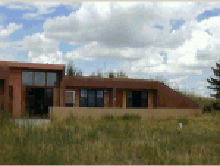
From the front, this ranch house in central New Mexico looks like a fairly typical, adobe-style home. On second glance, however, it becomes apparent that the greenery visible above the structure is too near to be the tops of backyard trees. Rather, it is a scattering of desert shrubs growing on the roof. It also becomes apparent that the courtyard wall extending out from the right-hand edge of the house is actually a retaining wall. Behind it, the ground clearly slopes up toward the house.



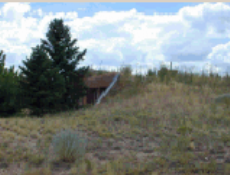
Walking to the right, past that wall, and looking back at the house, you see the building practically disappear into the earth. Although it was built at ground level, the structure is now covered with soil on the top and three of its four sides. Because there are no windows in the three bermed walls, the exposed wall consists almost entirely of glass that allows light to pour into the building's interior.
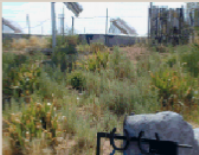
One of the primary advantages of earth sheltering is energy efficiency. Consider the example of Nancy Roux, who lives in an earth-sheltered home outside Mountainair, New Mexico. The elevation at her house is somewhat above the town's 6500 feet. In the month of January, the high temperature averages 46EF, with an average low of 19E. The average annual snowfall is 34 inches. Nancy has a wood stove and a fireplace in her cozy home, but she says they are merely decorative; she hasn't needed them for warmth. In fact, enjoying the holidays last December, she used her fireplace all day; finally, she had to open windows and skylights when the room temperature reached 95E. In this photo, taken from one side of the house, open skylights rise above the ground-level roof. Watch this site for more information about Nancy's lovely home, which she hand built, largely from discarded tires and empty beverage cans!
Earth sheltering can be quite effective for individual residences, but it can also be used on a larger scale. The Ann Ott Elementary School in Phoenix, Arizona, is one example. The insulation provided by the bermed walls certainly helps lower climate control costs, especially during the summer (the school operates on a year-round schedule). And installing basketball courts on the concrete-finished roof maximizes efficient use of the school's land area.
Unless otherwise attributed, all content is © Loretta Hall, 2000-2024.
But the most important factor in the decision to earth shelter the structure was noise--Sky Harbor Airport runways, which end less than two miles away, point directly at the school. Since an obsolete school facility was replaced with the bermed building in 1987, classes have not been disrupted by the jet airplanes roaring overhead.
The advantages of underground buildings can be realized to a significant extent in aboveground, bermed structures. This building style offers a viable compromise in cases like a near-surface rockbed that would be too costly to excavate. And it presents another choice for owners who seek benefits like noise reduction, security, and energy efficiency, but who aren't ready to take the plunge and build an even less conventional, truly underground building.
Thanks to real estate agent Patsy Gustin for showing us the Estancia ranch house and introducing us to Nancy Roux.
The advantages of underground buildings can be realized to a significant extent in aboveground, bermed structures. This building style offers a viable compromise in cases like a near-surface rockbed that would be too costly to excavate. And it presents another choice for owners who seek benefits like noise reduction, security, and energy efficiency, but who aren't ready to take the plunge and build an even less conventional, truly underground building.
Thanks to real estate agent Patsy Gustin for showing us the Estancia ranch house and introducing us to Nancy Roux.
Unless otherwise attributed, all SubsurfaceBuildings.com content is © Loretta Hall, 2000-2024.
But the most important factor in the decision to earth shelter the structure was noise--Sky Harbor Airport runways, which end less than two miles away, point directly at the school. Since an obsolete school facility was replaced with the bermed building in 1987, classes have not been disrupted by the jet airplanes roaring overhead.
The advantages of underground buildings can be realized to a significant extent in aboveground, bermed structures. This building style offers a viable compromise in cases like a near-surface rockbed that would be too costly to excavate. And it presents another choice for owners who seek benefits like noise reduction, security, and energy efficiency, but who aren't ready to take the plunge and build an even less conventional, truly underground building.
The advantages of underground buildings can be realized to a significant extent in aboveground, bermed structures. This building style offers a viable compromise in cases like a near-surface rockbed that would be too costly to excavate. And it presents another choice for owners who seek benefits like noise reduction, security, and energy efficiency, but who aren't ready to take the plunge and build an even less conventional, truly underground building.
Thanks to real estate agent Patsy Gustin for showing us the Estancia ranch house and introducing us to Nancy Roux.